GenAI for Practitioner · Putri Protocol · Series 2
The Empty Circle
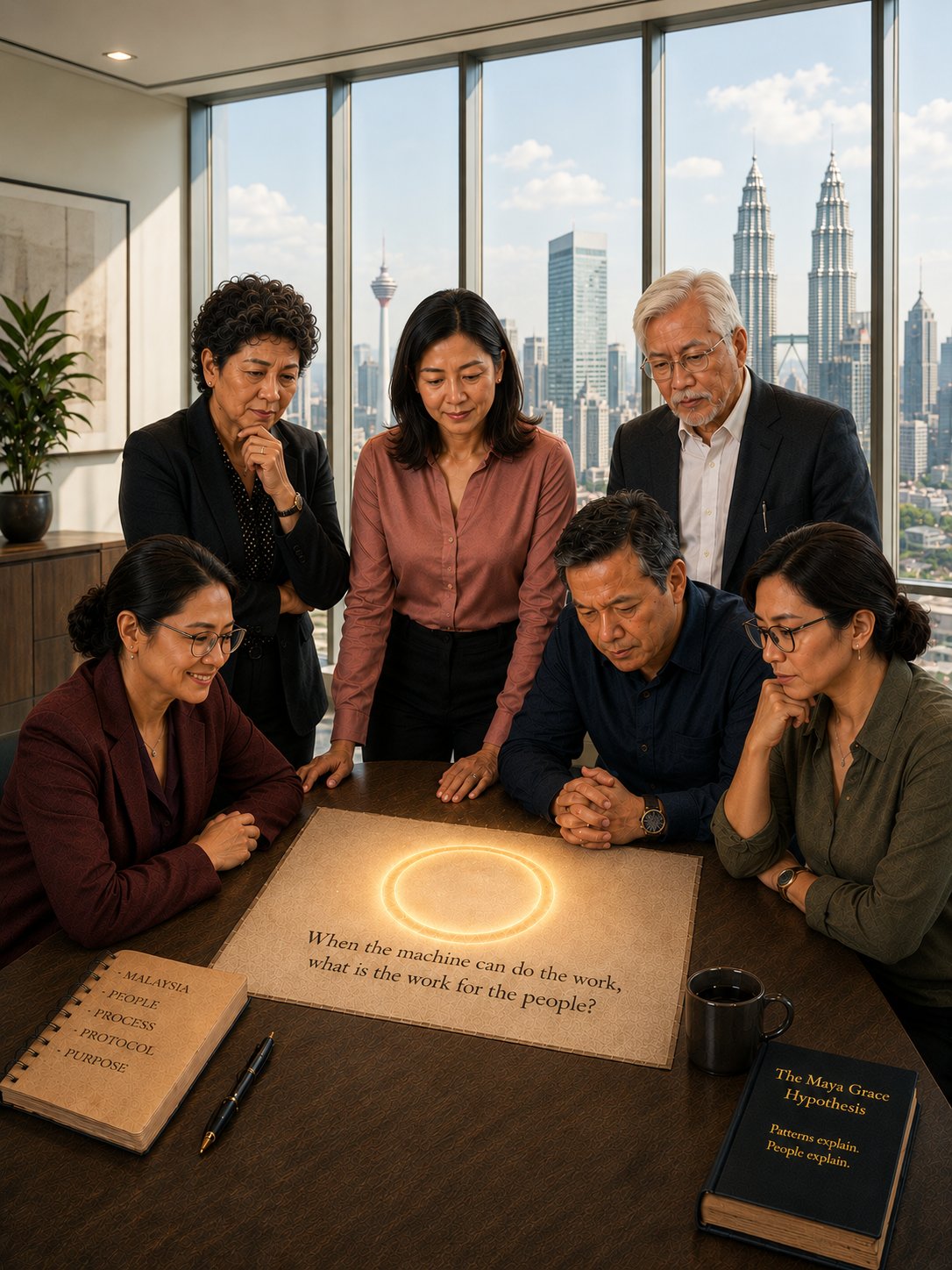
When the machine can do the work, what is the work for the people?
Series 2 begins on a Thursday in Petaling Jaya, at 1:14pm, when the ground moved.
The People in This Story · Click to meet them
Maya Chin
Amir
Putri
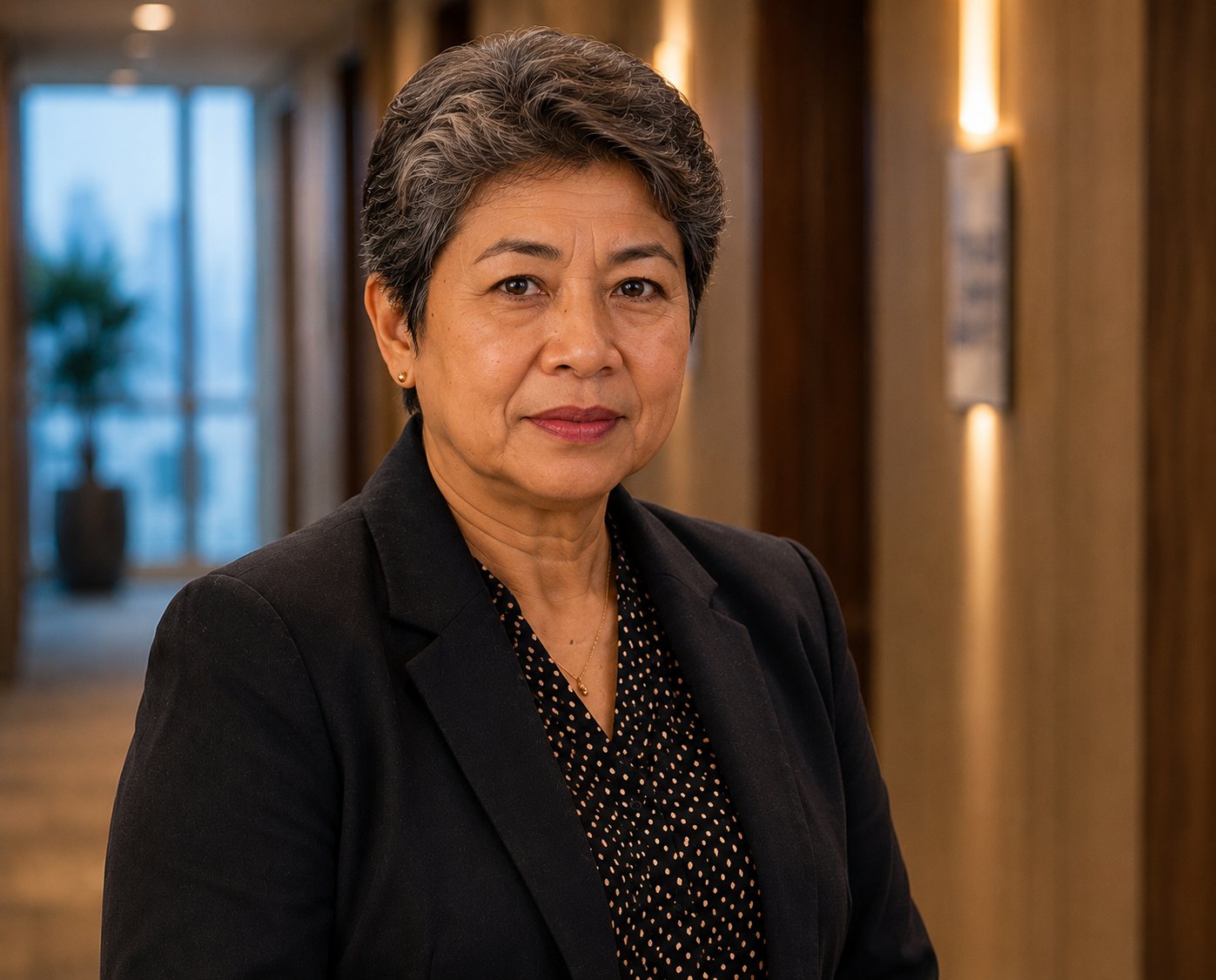
Dr. Rohini
Faridah
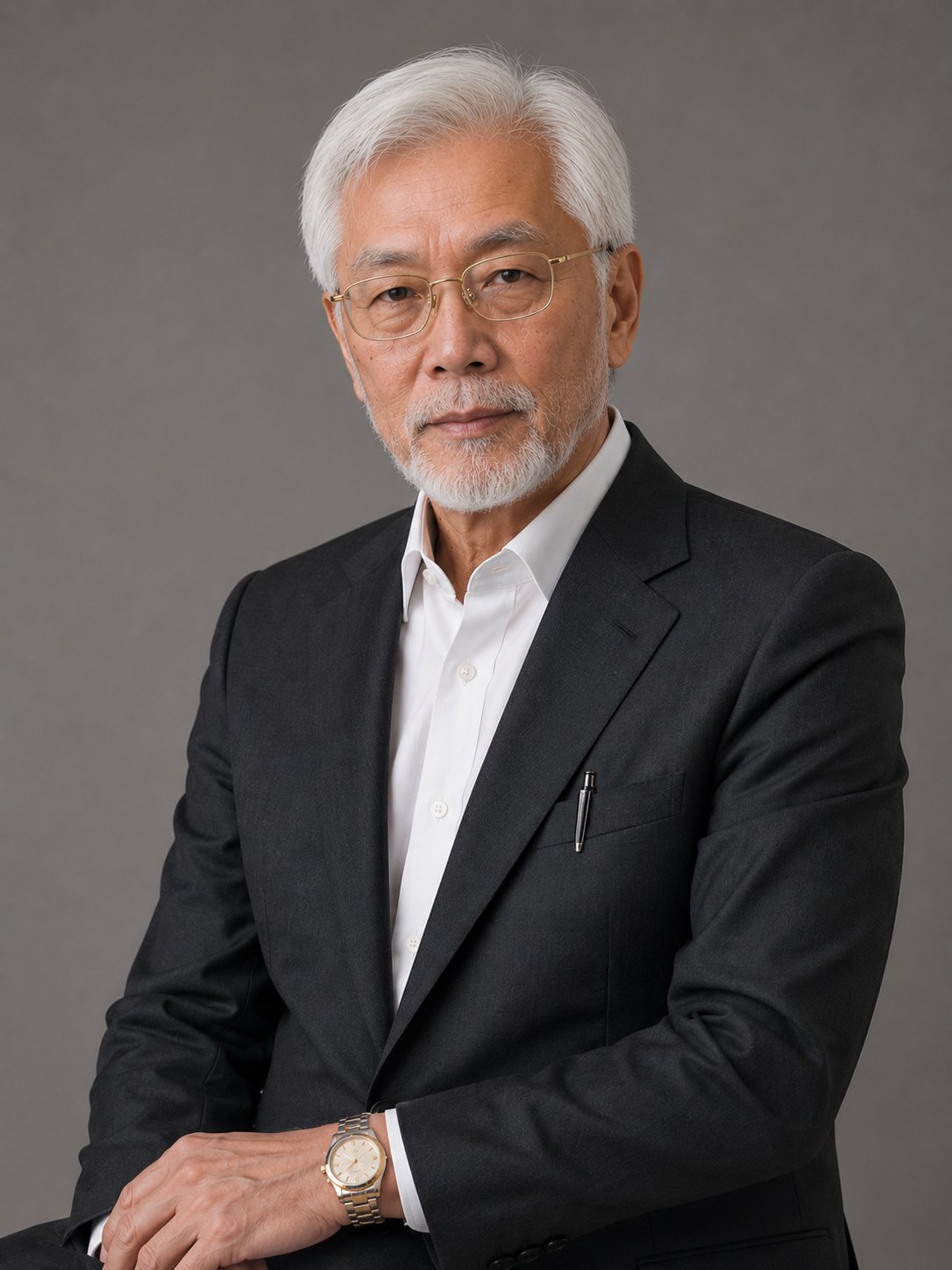
Tan Sri David Lim
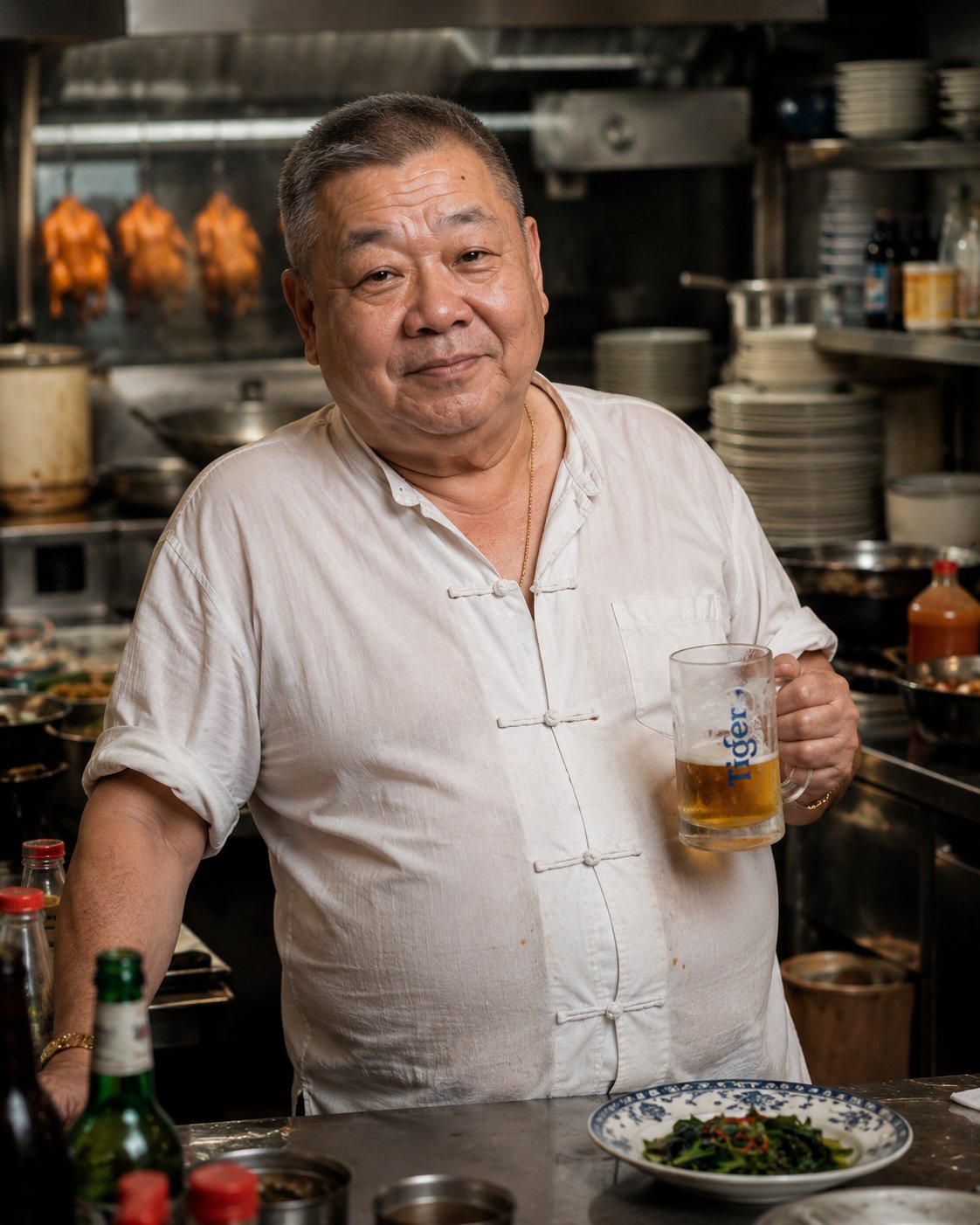
Mr. Ong
Kevin Ong
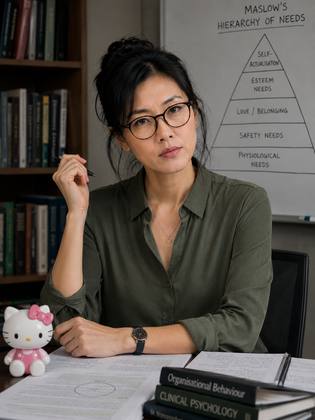
Grace
John Carrick
Andrew
Chapter IV
The Thursday the Ground Moved
A tender briefing cut short. Two emails from London on the same Sunday night.
Chapter V
The Boardroom on the 38th Floor
Putri corrects her own severance. The empty circle arrives at a tender table.
Chapter VI
The Letter Nobody Signs
A deferral. A full shelf emptied. A question nobody knew was the founder’s.
Where It Began · Series 1
The Putri Protocol
A report nobody checked, a folder named HOLD, and the analyst who caught all of it at a dining table in Petaling Jaya. The story that started the system.
A tender briefing cut off mid-sentence. Twenty seconds nobody in the city had ever rehearsed. A page with four circles — three coloured, one that nobody can fill in. Two emails from the same firm in London on the same Sunday night. And the question of the age, written at midnight: the machine can do the work — what is the work for the people?
XXIV
The Briefing, Interrupted
Ong's Restaurant, rooftop of the BrightBridge tower, Petaling Jaya · Thursday, 1:14pm
The invitation letter lay in the middle of the window table, and David had brought four printed copies of the brief, which was how everyone knew this was not a normal quarterly lunch.
The introductions he had made the year before had matured the way David's introductions tended to mature — slowly, and then all at once. One of the largest GLCs in the country was going to market for a workforce transformation advisory. Twelve thousand employees. Enterprise AI adoption, operating model redesign, capability assessment. Estimated value: USD 4 million — denominated in dollars because the transformation budget line was, which told its own quiet story about where the Group's advice on its own people would be coming from. It was the largest single engagement in the firm's thirty-year history. The invitation was international, and the field was deliberately small: five firms, three of them international, two of them Malaysian. And BrightBridge had not found it in a procurement portal, because it was not in a procurement portal. It had come by invitation, through the chairman, with one condition attached that he had saved for last.
David
"Submission is next Friday. Eight days. They are aware it is short. I believe it is deliberate — they want to see who can move."
He turned a page. The room was very quiet, the way rooms are when a number has just changed what a firm believes about itself.
"There is one scenario in the brief you need to read before you read anything else. They have asked bidders to assess — and I am quoting their own language — a workforce rationalisation of up to thirty per—"
The water moved first.
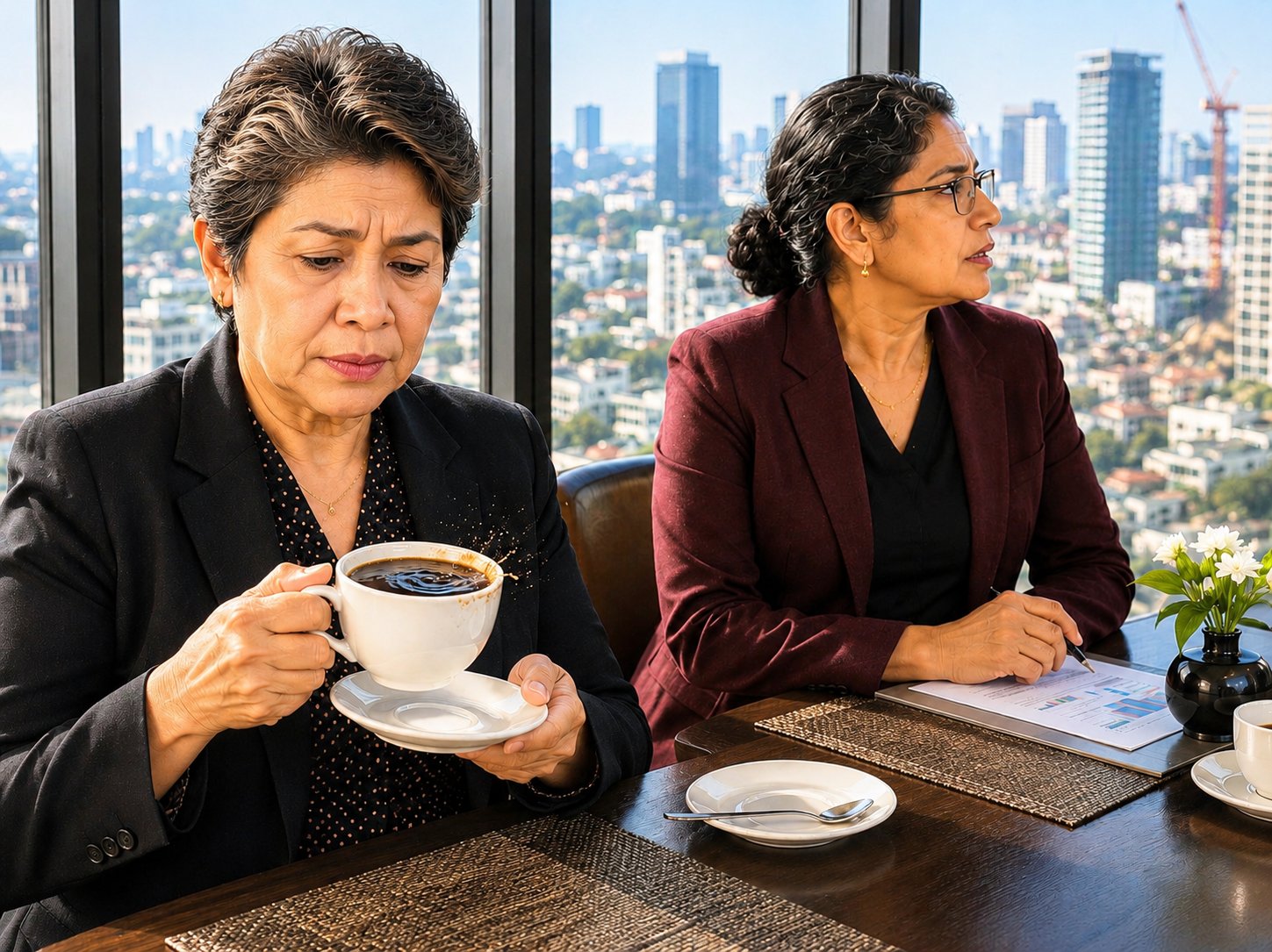
The surface of Dr. Rohini's glass tilted, recovered, and tilted again. Nobody had bumped the table. Then the building made a sound none of them had ever heard a building make. Not loud. Low. A groan that arrived through the floor and the chair legs and the soles of the feet before it arrived through the ears. The blinds swung. A fork went off the table by the pillar. The window did not move — but the skyline in it did, the towers holding still while the frame around them tilted one way and then the other, wrongly, like the city was being carried.
David put both hands flat on the table, on top of the brief, and said nothing — a man who had navigated three transitions, two crises, and a pandemic, wearing the stillness of someone meeting the first event of his career for which he had no file. Amir gripped the table edge, eyes on the window, watching the skyline do the thing skylines do not do. Faridah had one hand on her cup, holding it to its saucer. It was the only thing in the room she could keep from moving, so she kept it from moving.
Dr. Rohini was looking at none of them. She was looking across the room at Mr. Ong, who stood at the service counter with one hand resting on it — resting, not gripping — watching his room sway the way a man takes attendance.
Twenty seconds. The news would later say twenty seconds. At the window table it had no length at all.
The building settled. Mr. Ong spoke.
Mr. Ong
"The kitchen. Check the gas."
Faridah holds the cup steady on its saucer while the city holds still behind the window. Ong's Restaurant, BrightBridge tower, Petaling Jaya · Thursday, 1:14pm.
Kevin put the tray down and went. That was the first thing anyone in the building did about the earthquake: a man in his seventies, who had been answering the unprecedented with a task since 1995, gave somebody one.
David's sentence was never finished. Amir would notice it much later — that the last thing the old world said before the ground moved was up to thirty per — and that no one at the table ever heard the end of it.
XXV
The Pavement
The tower, the stairwell, the street · Thursday afternoon
Twelve floors of stairs, taken in office shoes, by people carrying laptops, handbags, and in one case a birthday cake that had been waiting in the Shared Services pantry since morning.
The pavement filled with the strange society of an evacuation — lanyards in the road, jackets over arms, three decades of the tower's tenants standing in the afternoon heat, looking up at the thing they worked inside. The tower looked exactly as it always looked. That was somehow the unsettling part.
Faridah came down the stairs the way everyone came down the stairs. It was on the pavement that she became Faridah. She did not count ninety people. She built the thing that counted them. Four team leaders, pulled out of the crowd by name. Every person reports to their team leader — safe, location, by message. By 6pm, all ninety were confirmed.
That evening, a seismologist from a local university was asked on the news whether it could happen again.
The seismologist, on the news
"There is no precedent for an event of this kind under the Klang Valley. Where there is no precedent, there is no model. I cannot give you a probability. Nobody can."
By 5pm there was hazard tape across the revolving door. The tower was sealed pending structural assessment. At the eastern edge of the skyline, the new crane had stopped mid-arc. Whatever it had been lifting when the ground moved, it was still holding. Mr. Ong looked up at his rooftop for a long moment, his room dark behind the glass. Then he went home.
XXVI
Friday, 8:40am
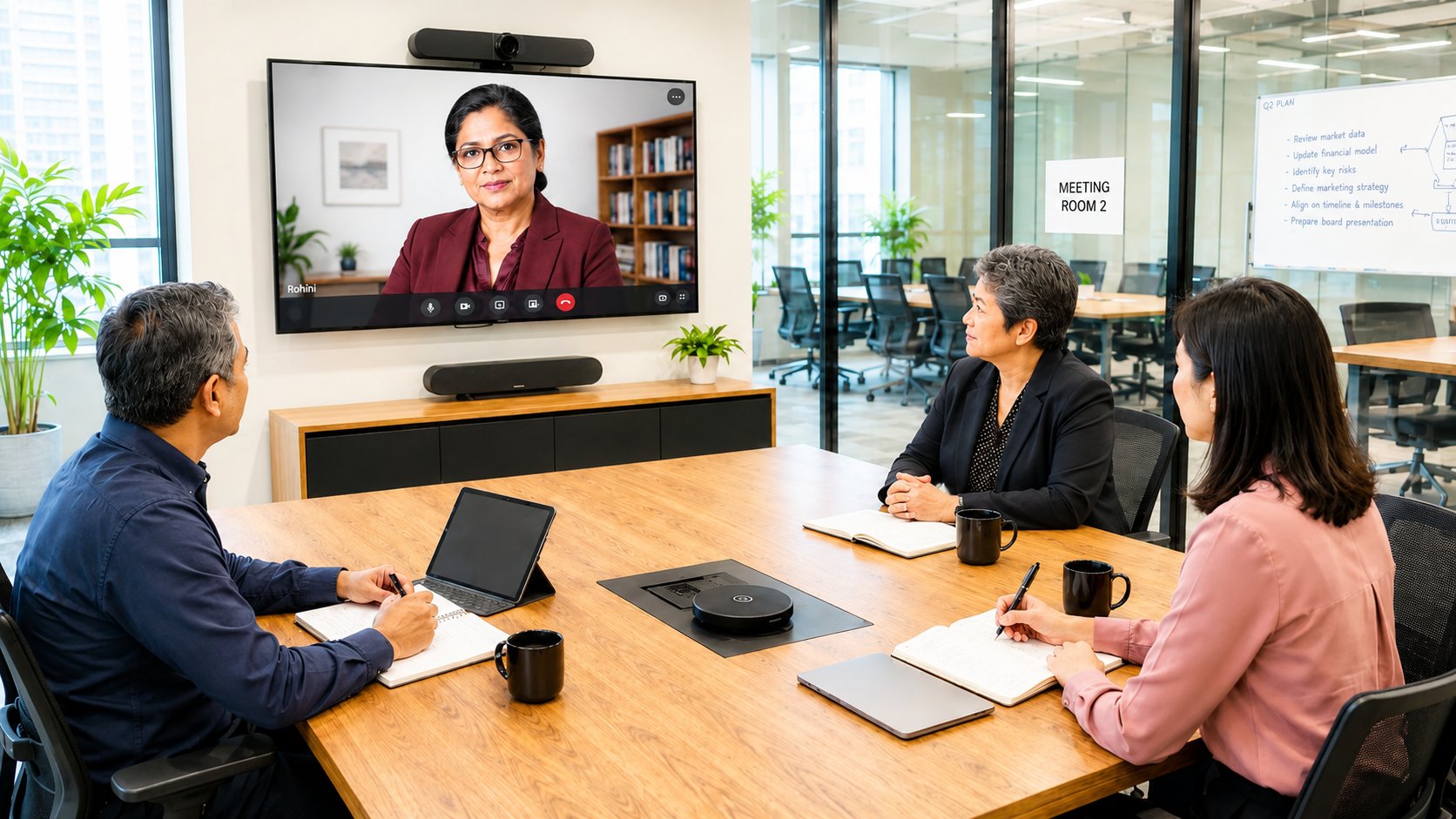
Meeting Room 2, Bangsar co-working floor · Dr. Rohini joins by video
Dr. Rohini on screen from her home study. Amir, Faridah, and Maya in Meeting Room 2, the borrowed Bangsar floor. Friday morning. Do we bid?
The co-working platforms told Faridah what platforms tell everyone in a city-wide emergency: nothing available, three-week waiting lists, prices that had learned about the earthquake faster than the government had. Faridah did not use the platforms. She called a man named Mr. Siva, a facilities director she had known for fifteen years — since the year a delivery crisis had stranded one of his tenants' submissions and Faridah had solved it overnight without being asked, because that was the kind of thing she did and the kind of thing he remembered. The call lasted eleven minutes. By 8:40am, BrightBridge had a floor in Bangsar: a glass room available immediately, twenty desks by Monday, terms agreed by phone and confirmed in one email.
A fifteen-year relationship had just done in forty minutes what the systems said would take three weeks. She walked the floor at noon — hot desks, borrowed acoustics, a neon sign on the far wall that said GOOD VIBES ONLY, which she switched off on her way out and which, she would discover, came back on automatically every day at twelve.
At 10am the firm convened by video — ninety faces in boxes, a company attending its own continuity — and made the week's second discovery: nothing that mattered had been in the building. The interaction logs, the master sheet, the verification column — all of it lived in the cloud, indifferent to postcodes.
At three o'clock, the question that could not wait joined the borrowed room by screen. Dr. Rohini's face appeared on the wall panel of Meeting Room 2 — burgundy blazer, glasses, the study behind her with the weekend's work already visible on the desk — and the firm's three most senior people on the ground arranged themselves around the table to decide.
Maya
"The global firms deliver with AI now. The cuts they've announced are in the back office and the junior research level."
She paused, and finished it evenly, as a fact about the market. "The junior research level is the work I do."
Amir
"They say they're not replacing people. They say they're redefining roles. Nobody outside the firm knows which is true."
He took off his glasses.
"Possibly nobody inside either."
It was the sentence of the season, being said in a thousand rooms in a hundred ways. Every week now brought another announcement — a bank's research desk, a law firm's first-years, a translation department that had existed for thirty years and then, one Tuesday, did not. The press releases all used the same word: redefining.
Dr. Rohini · on screen
"We bid. Amir, Maya — the proposal is yours. Drafts by Wednesday, final by Friday noon. Faridah — everything they need, they get."
It was decisive, and everyone heard it as decisive — a managing director calling a decision from a screen, across a broken city, into a borrowed room — and only Dr. Rohini knew she had decided the smallest of the questions in front of her, because it was the only one with a deadline attached.
XXVII
The Weekend Draft
Two homes, one shared document · Saturday and Sunday
The document grew the way shared documents grow — in two colours, at strange hours. And every section they wrote about the GLC's workforce interrogated them back. On Sunday afternoon they hit the wall. They began mapping the GLC's roles against the traffic light classification — Red, Amber, Green. For one productive hour it worked. Then Maya stopped typing and called him.
Maya
"The framework classifies what the AI produces. Risk of error, need for checking. Every colour we have is about what the machine might get wrong. The brief is asking what the people might become. That's not a risk axis. It's not on this chart at all."
She shared her screen. She had drawn the three circles on a blank page — red, amber, green — and then, beside them, a fourth circle. It was empty. It sat beside the three coloured ones the way a question sits beside three answers.
Maya
"There's a case our framework has no colour for. Where the AI doesn't just get checked by a human — it makes the human capable of something they weren't before. Nobody can tell you what goes in it. And it's the only one the client's twelve thousand people would actually want to hear about."
Amir
"We can't fill it. We're writing a chapter about human behaviour, and neither of us has ever studied human behaviour."
Maya
"There's someone at my church. Grace. She's a psychologist — clinical, eight years — and now she's doing her PhD on organisational behaviour in the age of AI. She has been talking about exactly this for a year. And I have been nodding politely."
Amir
"Call her."
In the master document, the section heading sat with nothing underneath: 3.4 — The Role of the Workforce. That night Amir took out his notebook. He drew. Three circles, shaded. A fourth, empty. Under the circles, he wrote:
Amir's notebook — Sunday night
The machine can do the work. What is the work for the people? No one bidding on this knows. Including us. Maybe Grace.
XXVIII
The Email
Dr. Rohini's home study · Sunday, 9:15pm
It arrived while she was reading the weekend draft. Three paragraphs. No attachments. From the managing partner of Atherton Hale, London. They knew the firm's history. They used her father's name correctly and respectfully. They said, in the language of such letters, that Atherton Hale was expanding into ASEAN and would welcome a conversation regarding the acquisition of BrightBridge as the platform for that expansion. She understood the structure on the first read. They were not buying what BrightBridge did. They were buying who BrightBridge knew. The email did not mention the earthquake. Not one word. The timing said everything the drafting was too good to say. She did not reply. She did not delete it. She created a folder and typed the name of the day everything had started moving. THURSDAY.
XXIX
The Other Email
Amir's kitchen · the same Sunday, 11:40pm
Atherton Hale. A different name at the bottom — a partner on the ASEAN expansion team — but the same letterhead. They knew his MoH work. They would welcome a conversation regarding the post of Country Manager, Government Services, Malaysia. He read it twice. Across town, in a study he had sat in many times, the same firm's other letter lay filed in a folder named THURSDAY — and he did not know that, and she did not know about this one, and they were two people who told each other everything about the business, and tonight, separately, in two quiet rooms, each of them was deciding to mention nothing.
· · ·
Coming Next — Chapter V
The Boardroom on the 38th Floor
Putri corrects her own severance. The empty circle arrives at a tender table.
GenAI for Practitioner
The verification discipline. The governance system. The questions a board has to answer before it trusts the machine. The programme is built around exactly these situations — live, from your actual job.
A Sunday dinner, three hours before everything. A Monday call that begins exactly on time. A boardroom with traffic lights on every slide and no fourth circle anywhere. A psychologist who turns the empty circle toward them like a scan — and refuses to fill it. A salesman outside the briefing hall, reporting to a voice in London. And two files on a screen the night before the deadline: the one that wins, and the one that's true.
XXX
Sunday, Seven O'Clock
Amir's home, Petaling Jaya · Sunday evening
Before the two emails from London, before the folder named THURSDAY, before any of it — there was rendang.
Putri's mother had started at three, under instruction, and at seven o'clock precisely it was on the table, which the family treated as a minor miracle and she treated as proof that instructions work. For an hour the week receded. The earthquake was discussed the way Malaysians had been discussing it for three days — where were you, what moved, who called whom first — already becoming a story, the way the unprecedented does once everyone has survived it.
Putri ate well and said slightly less than usual. Amir noticed, and did not say so. He had spent more than twenty years across tables from people carrying things they had not yet decided to put down, and he knew the only thing that worked was room.
It was at the sink, afterwards, drying dishes neither of them needed to dry, that he asked her his question. He kept the details out of it — no client, no numbers, nothing that belonged to the office. Just the shape of it.
Amir
"A thinking exercise. Say a machine can do most of the work an organisation's people do. Someone has to write the chapter on what the people are for now. What does the chapter say?"
Putri
"That's the wrong question, Ayah. What are people for — that's the machine's question. You're asking what's left after the machine takes its share. Ask it the other way."
Amir
"Which way?"
Putri
"Ask what only people notice."
She put the plate down. "Every system I've ever worked on does exactly what it's told and notices nothing it wasn't told to watch. The people around it are the only part that looks up. That's not what's left over, Ayah. That's the actual job."
He stood there with the towel in his hands, doing the thing he did with sentences that mattered: reading it again, slowly, from the beginning.
She left at ten, with a container for her freezer and instructions she would not follow about not eating it standing up. At the gate she paused, half-turned, as if to add something — about Monday, perhaps — and then didn't.
Putri
"Thanks for dinner. Tell Mak the timing was perfect and I'll never admit it again."
He watched her car to the end of the road. He did not know what he was watching. Ninety minutes later, in a study across town, the first email arrived. Two hours after that, in this kitchen, the second. But that was Sunday night. This was Sunday evening, and for one more hour, everything was rendang.
XXXI
Monday, 9:00am Sharp
Putri's office, Kuala Lumpur
Conference call.
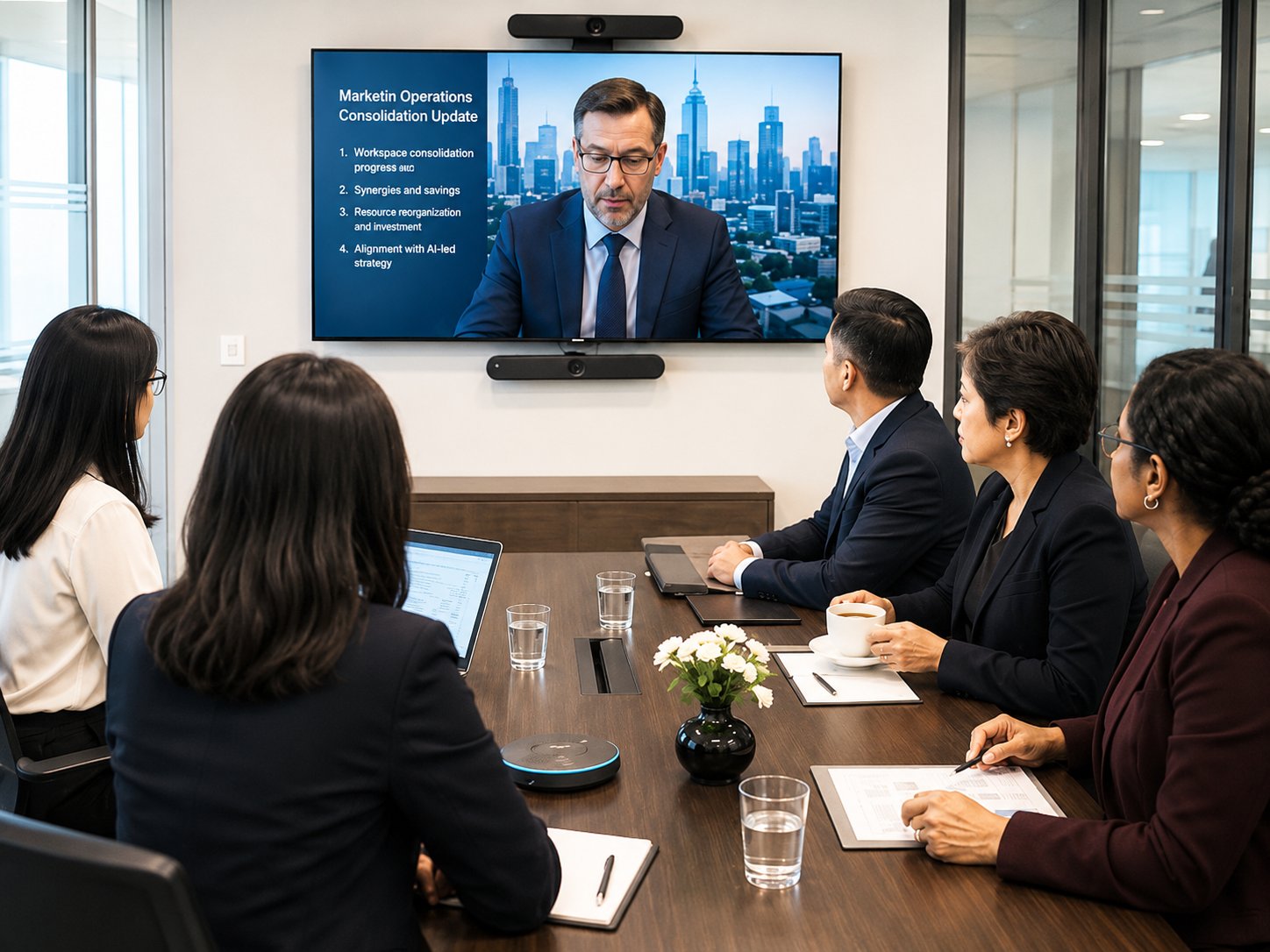
The review call began exactly on time, which told everyone on it what kind of call it was. Good news is casual. Good news is five minutes late and starts with how is everybody.
The Malaysian operations of the group, he read, were being consolidated. He gave four reasons. Regulatory data-localisation requirements had materially increased the cost base. The group was exercising regional cost discipline in a challenging environment. Recent events in Kuala Lumpur had prompted a reassessment of business continuity risk. And the consolidation aligned with the group's strategic direction, announced by the chief executive at the last investor day, of becoming — he read the phrase exactly as it had been written for him — an AI-first organisation.
Putri counted the reasons. Four. Later, trying to explain to her father which one was real, she would find that she could not — that the regulation was real and the cost pressure was real and the earthquake had happened and the chief executive had certainly said the words — and that the four of them together added up to a decision nobody could be said to have made for any reason in particular. There was a word going around for it that year. She would use it on the phone that night, flatly: nobody can even tell anymore whether the AI took the jobs or just took the blame.
The affected function was the regional data quality and model validation team. All Malaysian roles. Thirty days' notice. The group regularly reviewed and adjusted its staffing needs; these decisions were made after careful consideration; the group was committed to providing support to affected colleagues during this period of transition.
He then thanked the team for their contributions, and mispronounced the team lead's name. Thinagaran had been with the group for nine years. The man on the screen read his name as if it were three separate words he was encountering for the first time, because it was.
Putri sat very still through all of it. Then came slide 14 — the severance framework — and she saw two things at once. The first was that the worked example for Band 6 had a name on it. Hers. Whoever had built the deck had pulled a live row to illustrate the calculation and had forgotten to anonymise it — and so her own severance, her own grade, her own tenure, sat on the screen in front of forty people, demonstrating the formula by which she was being let go. It was a data hygiene failure of the precise kind her team existed to catch. The second was that the figure was wrong.
Putri
"Slide fourteen. Two findings. The severance formula excludes fixed allowances — for anyone on a pre-2023 contract, that's not compliant with the employment terms, and you'll want to rerun it before the letters go out. And the worked example is built from a live employee record. It should have been anonymised."
She did not say: the record is mine. It was in the room anyway. Forty people could read.
A pause, while somewhere in another country someone checked.
The Vice-President
"Thank you for flagging. We'll have both corrected. We are committed to supporting affected colleagues through this transition."
And so the last verified deliverable of the regional data quality and model validation team was the accurate computation of its own severance — caught by the function being eliminated, in the meeting eliminating it, on a slide that carried, by accident, the name of the person who caught it.
That night she rang her father. She did not cry, because she was Putri, and she said most of it in numbers, because she was Putri. It was only at the end that she said the other thing, in the flat voice she saved for findings.
Putri · on the phone to Amir, that night
"You know what they kept, Ayah? Every system that didn't notice the earthquake. And they released the people whose job was noticing."
A breath. "The machine didn't notice the earthquake. And neither did the people who decided."
She had not called her mother. Her mother's first question would be so what will you get — which was not coldness; arithmetic was how her mother loved — and Putri did not intend to answer it with a number that was wrong. The letters were being rerun. She would call tomorrow, when the figure was correct, and her mother could love her accurately.
Across the region that month, the same call was happening in other rooms, read by other vice-presidents in the same careful voice. The wave had a vocabulary now — consolidation, alignment, AI-first — and nowhere in the vocabulary was the question the people on those calls carried home: what, now, is the work for us?
Amir held the phone and looked at the kitchen where, twenty-four hours earlier, she had told him what the actual job was. The email from Atherton Hale sat unanswered in the same house, in the same inbox, a day old. He did not mention it. There was no version of this night in which he mentioned it.
XXXII
Tuesday, the 38th Floor
GLC headquarters, Kuala Lumpur · the bidders' clarification session
Five firms had been invited. Two attended the clarification session. Whether the other three had not been told in time, or had calculated that eight days was not enough runway to attend and still submit, John Carrick had his own view and had not shared it with anyone but himself.
If the earthquake had reached the 38th floor, nobody mentioned it. The lifts were express, the marble was unmarked, the coffee arrived on trays, and the city below — the taped doorways, the frozen crane, the committees deciding who was allowed to answer questions — was a view.
The Group CEO opened the session himself, which the procurement team clearly considered an honour, and which he clearly considered important, because he was not a cynical man. He was intelligent, fluent, and generous with his forty minutes, and every substantive thing he said had been said to him first, somewhere else, from a stage.
He told the room that agentic AI would absorb forty per cent of knowledge work within two years — he had heard it in Singapore last month, he said, from someone who would know. He described a demonstration he had been given at a summit in which an AI agent had completed in nine minutes a piece of analysis his own people took three weeks to produce — he did not say whether anyone had checked the nine-minute version, and the question did not appear to have occurred to him. He used the phrase do more with less twice and the phrase our people are our greatest asset once, in that order.
Amir, three rows back beside Maya, recognised the condition. It was not stupidity. It was diet. The man was assembled from conferences, and he was doing his sincere best with what he had been fed.
Twelve thousand people worked beneath him, and the brief on the table proposed that up to thirty per cent of them be assessed for rationalisation, and there was no evidence in his forty minutes that he had ever asked any of them anything. Beside Amir, Maya was drawing in the corner of her pad — three small circles and a fourth one, empty. Forty minutes of presentation. Traffic lights everywhere. The fourth circle appeared nowhere.
It was Maya who read the lanyard two seats to her left, and wrote three words on her pad and tilted it toward Amir: Atherton Hale — here.
John Carrick · Atherton Hale · Regional Director, ASEAN (Designate)
Late forties. Composed. Took almost no notes — in the manner of a salesman who had stopped writing down slides twenty years ago and now wrote down only people. Twice during the CEO's forty minutes his eyes moved along the row of deputies, unhurried, the way a man prices a queue.
Amir · Q&A
"Your pilot programmes are in production today, generating analysis your divisions are using. Could you name for us — not the policy, the person — who verifies that output before it is relied upon?"
The Deputy
"We'll take that offline."
At the side table, the woman taking the minutes stopped typing, looked up at Amir for one second longer than protocol required, and then looked back down at her keyboard. She wore a lanyard from the GLC's own transformation office.
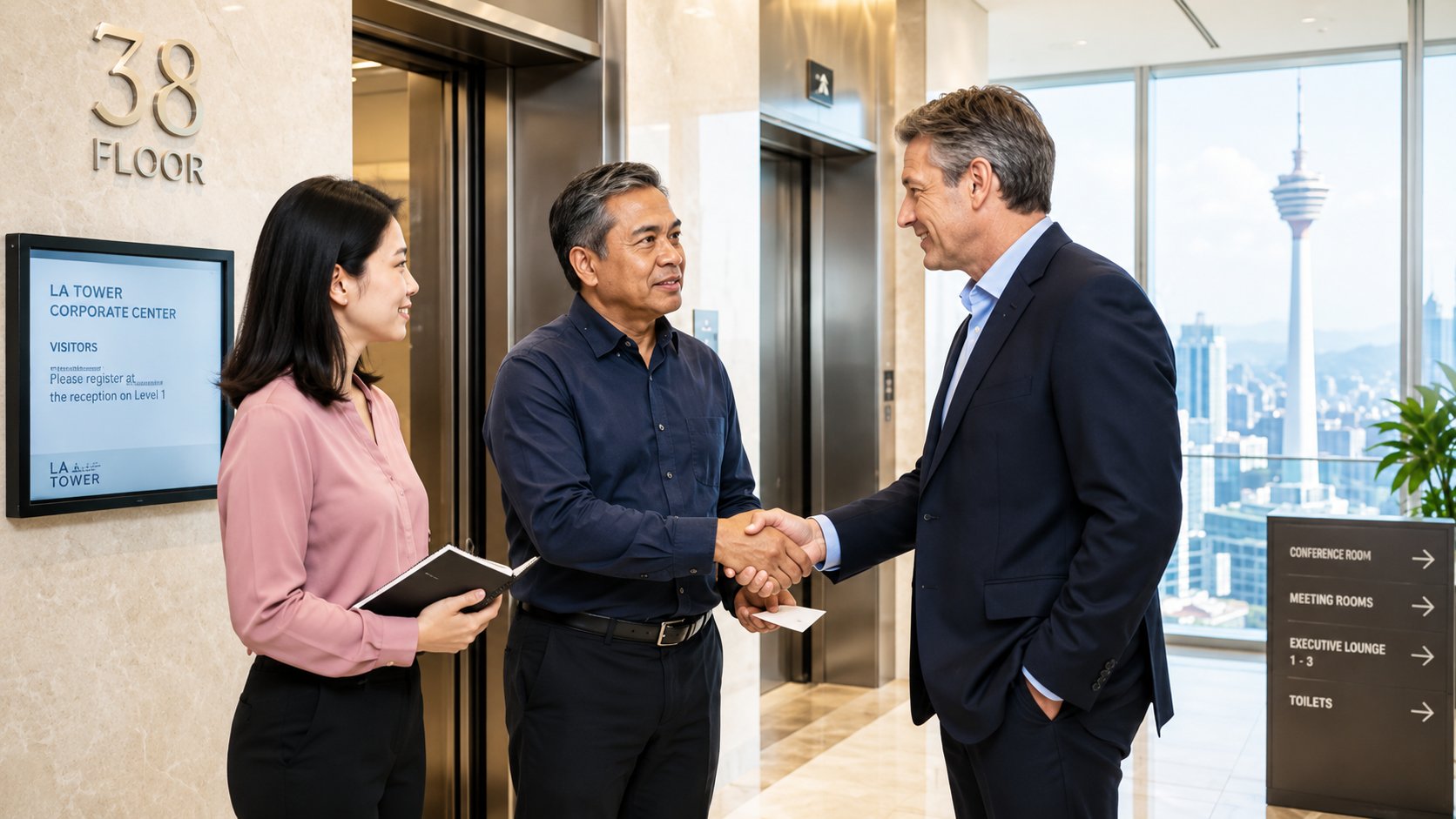
Outside the briefing hall, 38th floor. Carrick gives Amir his card. Maya stands left, notebook in hand. KL Tower through the window. GLC Tender Clarification Session — Tuesday.
It was over by noon. Outside the briefing hall, Carrick was suddenly beside Amir — hand extended, both names pronounced perfectly.
John Carrick
"Encik Amir. Your Ministry of Health work has admirers in our London office. My colleague wrote to you on Sunday, I believe. No response is expected yet. We are patient people."
He held out a card. There is no graceful way to refuse a card outside a briefing hall, and the man knew it. Amir took it. It went into his jacket pocket, where the notebook was. He told Maya about the question and the minute-taker. He did not tell her about the card.
XXXIII
The Departure Lounge
KLIA, Gate C17 · Tuesday, 9:05pm
John Carrick ran the same day for a different audience, from a seat by the glass at Gate C17, watching his aircraft being fed. He called before the flight, because Andrew preferred it that way.
John
"Two in the room. Out of five invited."
Andrew
"The others didn't attend?"
John
"The timeline was eight days. You need to know about a tender before the portal to attend a clarification eight days before close. The other three had the same notice as everyone else."
He paused. "BrightBridge had a different kind of notice. Ninety people, building sealed by the quake, working out of a co-working floor in Bangsar. The founder's daughter runs it. On paper they shouldn't be in the room. But they were in the room because someone thought to tell them — someone who knew, before the portal did. Their government man asked the only real question of the morning. Who verifies the pilots' output — the person, not the policy. The minute-taker stopped typing when he asked it."
Andrew
"So they have a relationship that got them into the room."
John
"The same way we do."
Andrew
"Did you give him the card?"
John
"Outside the briefing hall. Both names, correctly. He took it."
Andrew
"People reply to offers, John. They live with inevitabilities. Let them live with it."
He boarded, took the window seat he would not look out of, and slept before the seatbelt sign went off — the practised sleep of a man who was extremely good at his job and made a point of not asking himself, at altitude, when exactly he had decided to be.
XXXIV
Wednesday, the Kopitiam
A kopitiam off Jalan Telawi, Bangsar · 6:30pm
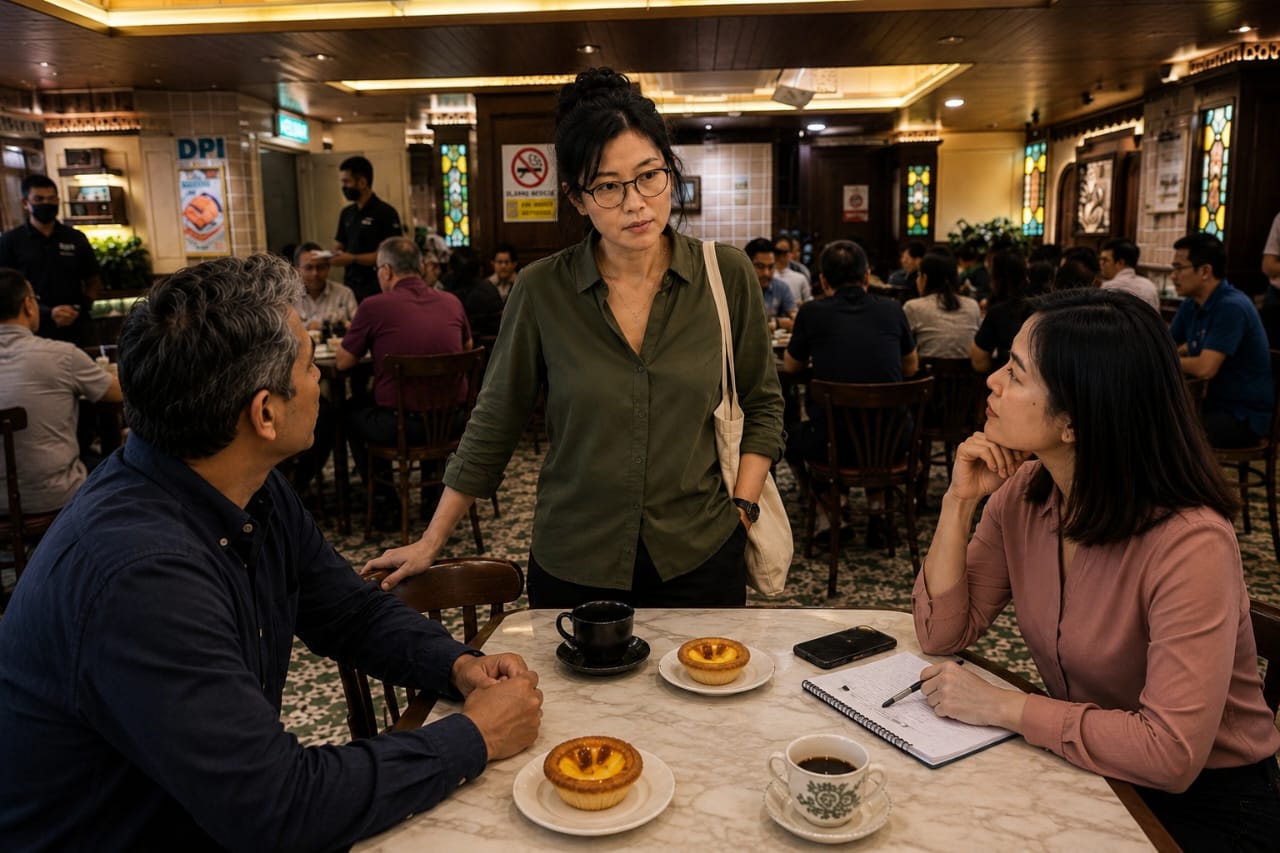
Grace arrives at the table. Amir and Maya wait. Marble tops, wooden chairs, egg tarts, kopi. Bangsar kopitiam, Wednesday evening.
Grace arrived on time, ordered kopi kurang manis, and listened to the whole thing without once interrupting. She listened the way clinicians listen: completely, and without rescuing anyone from their own sentence. Maya put the page on the table between the cups. Three circles, coloured. A fourth, empty. Grace looked at it for a long moment. Then she turned the page around so the empty circle faced them — the way clinicians turn a scan toward a family.
Grace
"You've found the difference between risk and potential. Your three colours manage what the machine might get wrong. The fourth one isn't about the machine at all. It's about what the human might become with the machine. Different question. Different hundred years of research."
Grace
"Wherever the literature looks at people who come through a technological shift larger instead of smaller, the same handful of things keeps showing up."
She counted them off on the table, one finger at a time: "They have some say in their own story. Someone actually guides them — real feedback from a real person. They belong somewhere, and somebody credible believes they can grow. The technology is fitted to the person, not the person to the technology. The hard period itself becomes the training — the disruption is the curriculum. And the learning never closes. Six things. No magic in any of them. The magic is that almost no organisation does more than two."
Amir
"Forgive me. I have read sentences very like those six. Usually on a poster in a client's lobby, near the lifts."
Grace
"So have I. That's the tragedy of them — they sound like a poster and they behave like physics. The real version costs the one thing organisations least want to spend: senior people's sustained attention, on individuals, repeatedly, with no dashboard to show for it."
"The technology doesn't add capability evenly. It amplifies whatever it lands on. Put it in the hands of a developed person inside a healthy organisation, and it multiplies them. Put it in an undeveloped person inside a frightened organisation, and it multiplies that instead. It's not a skills story. It's a soil story. Your fourth circle was never a technology question. It's a development question wearing a technology costume."
Grace
"One free professional opinion, since the kopi's on you. Whatever you end up bidding — keep this circle empty on the page. The first vendor who offers to fill it in for a fee, that's how you'll know they're lying."
Grace · at the five-foot way
"Out of interest — your firm. Which circle are you in?"
Amir
"I'll tell you when I know."
XXXV
Thursday, Two Folders
Bangsar, the glass room · Thursday, 5:00pm
Maya had built two complete bids, because she could not make them one.
What Wins
AI-lean delivery. Agents for research, synthesis, first drafts; a thin senior layer for judgment and client work; priced to come in under the global firms. The delivery model, costed honestly, priced the junior research function at approximately zero. She had checked the formula twice. The formula was correct. That was the problem with it.
What We Believe
The verification architecture scaled to twelve thousand people, and section 3.4 no longer empty — built on a question from a dining table (ask what only people notice) and six plain findings from a kopitiam, drafted into something no other bidder would be carrying: a workforce chapter about what the twelve thousand could become, with the disruption itself as the curriculum. Most of 3.4 was Amir's drafting. He had written the chapter on what twelve thousand strangers could become in the same week a formula had decided what his own daughter no longer was — and he had not said so once, and Maya, who knew, had not said so either. It was the only section in any bid that would land on the 38th floor written by somebody with skin in it, and it read that way. And in its appendix, a diagram no tender in the country had ever carried: four circles — three coloured and named, the fourth left deliberately empty — with a single sentence beneath: This circle cannot be bought or installed. It can only be grown. This proposal is a method for growing it. Honest, unlike anything else that would land on the 38th floor, and forty per cent more expensive than the other folder.
She presented both to Dr. Rohini without a recommendation, which in four years she had never once done.
Dr. Rohini
"You always bring me a recommendation."
Maya
"One of these I can't believe in. The other one I can't promise. I'm not going to pretend that's a recommendation."
Dr. Rohini looked at the two folders on the shared screen for a long time.
Dr. Rohini
"Thank you for not pretending."
XXXVI
Thursday Night
The glass room, Bangsar · 9:40pm
She had driven past the tower on the way to Bangsar, which was not on the way. The car had simply made the old turning. She let the car slow almost to a stop, and looked up at the dark glass. Then the light ahead turned green, and she drove on, because she was not ready to stand on a pavement looking up at her father's firm like a mourner.
Dr. Rohini and Faridah sat at the rented table with the two folders open on the screen. WHAT WINS. WHAT WE BELIEVE. Noon was fourteen hours away.
Dr. Rohini
"More than twenty years, Faridah. Whenever I've asked you whether this firm can deliver something, you have always known. So tell me. Can we win this with the one we believe in?"
Faridah
"I don't know."
She did not soften it, and she did not fill the silence after it, because both of those things would have been less than the truth, and in more than twenty years she had never once given Dr. Krishnamurthy's firm less than the truth.
· · ·
Coming Next — Chapter VI
The Letter Nobody Signs
A deferral. A full shelf emptied. A question nobody knew was the founder’s.
GenAI for Practitioner
The verification discipline. The governance system. The questions a board has to answer before it trusts the machine. The programme is built around exactly these situations — live, from your actual job.
A decision made at 11:51am, nine minutes before good vibes. An empty circle goes upstairs in a government tender. A structural report nobody will put their name to. A Thursday letter that awards nothing — and the telephone call on the other side of it. And at a rented table, the firm's youngest asks the founder's question — without knowing whose it is.
XXXVII
Friday, 11:51am
The glass room, Bangsar
Dr. Rohini arrived at seven, before the desks, before the coffee. Somewhere around three in the morning she had stopped asking the question she had been asking — which bid wins — because it was unanswerable, and Faridah had had the honesty to say so. She reached, the way she always reached at three in the morning, for her father — not for what he would have chosen, but for how he chose.
What do you want your board to say about this in two years?
In two years, the further side of all of this — the quake, the tender, the folder named THURSDAY — what did she want said about the firm her father had built? That it had been competitive? Or that, in the year nobody knew anything, it had been honest — that it had written down what it knew, written down what it did not, and moved first? It was not even a close question, once it was the question.
At 9:40am she did the last thing, the thing that made the bid hers and not just Maya's and Amir's. Into the executive summary, above the methodology, she inserted a section no procurement evaluator in the country would have seen before, and wrote it herself, in eleven sentences. The first three read:
Section 1.3 — What We Do Not Know
"No party to this procurement — no bidder, no vendor, no adviser, and not this firm — can state with evidence what proportion of knowledge work machine systems will absorb, or by when. The restructurings now under way at the global firms cannot be cleanly attributed even by the firms themselves. It follows that any proposal guaranteeing a precise workforce outcome in this environment is guaranteeing the unknowable, and should be evaluated accordingly."
Eight more sentences followed. None of them walked the first three back. The last one said what the firm was actually selling: a methodology built for exactly this condition — not to predict the ground, but to remain standing while it moved.
Amir read it at 10:15 and took off his glasses, and did not say anything, because there was nothing to add — which, from Amir, was the review.
At 11:51am, with the whole firm's leadership crowded behind one laptop like a family around an oven, Maya clicked Submit. WHAT WE BELIEVE left the building. At 12:00 noon exactly, GOOD VIBES ONLY flickered on, nine minutes too late to take any credit.
XXXVIII
The Signature
A kopitiam below Mr. Ong's flat, Petaling Jaya · three weeks after the ground moved
The structural engineer's report had been complete for a week. Ninety-six pages. Its conclusion was that the tower's bones were sound. What it could not do was open the building, because a report is not a permission. Kevin arrived at the kopitiam with a laptop and the soft, braced voice of a son about to be sensible at his father.
Kevin
"Pa. Three units. Two in Section 17, one near Jaya One. Every projection says rooftop dining doesn't recover to baseline. People don't want to be up high anymore. Not for a while."
Mr. Ong
"Thirty years ago the models said nobody would take a lift to the roof of an office tower in PJ to eat. I did not look at those either."
Mr. Ong
"I am not waiting for courage."
He set the cup down.
"I am waiting for a signature. These are different things. Courage they do not have — that, I cannot fix, and I am too old to teach it. But a signature is just a name and a pen, and one day the queue of people refusing to be the name will end, because queues end."
He looked out at the five-foot way, at PJ going past.
Mr. Ong
"The room is sound, Kevin. The engineer says so, ninety-six pages. The only thing broken is the part of the country that says so out loud. I will not move thirty years downstairs because the men with the file are frightened of their own pens."
Every morning that week, as he had every morning since the tape went up, he walked to the tower and stood on the pavement and looked at the top of it. He was not inspecting anything. Anyone watching would have understood, eventually, that he was visiting.
XXXIX
Thirty Days
Putri's office, Kuala Lumpur · the notice period
Nobody had asked her to do it. The group's systems held every procedure her team had ever documented; what they did not hold was everything her team had never needed to document, because the team had been the documentation. So she wrote it down. All of it. A wiki, ruthlessly indexed, titled with the only sentimentality she permitted herself:
For Whoever the Next People Are
Thinagaran found it in the third week and added his nine years to it without either of them discussing the matter. By the end of the month it held things the group did not know it knew, written by people the group had decided it did not need, for people the group had not yet realised it would have to hire.
On the second Saturday of her notice period she enrolled in a weekend programme on self-leadership. Her reason, written in the registration form: If nobody can tell me what humans are for now, I will go and find out.
XL
The Presentation
GLC headquarters, the 38th floor · presentation day
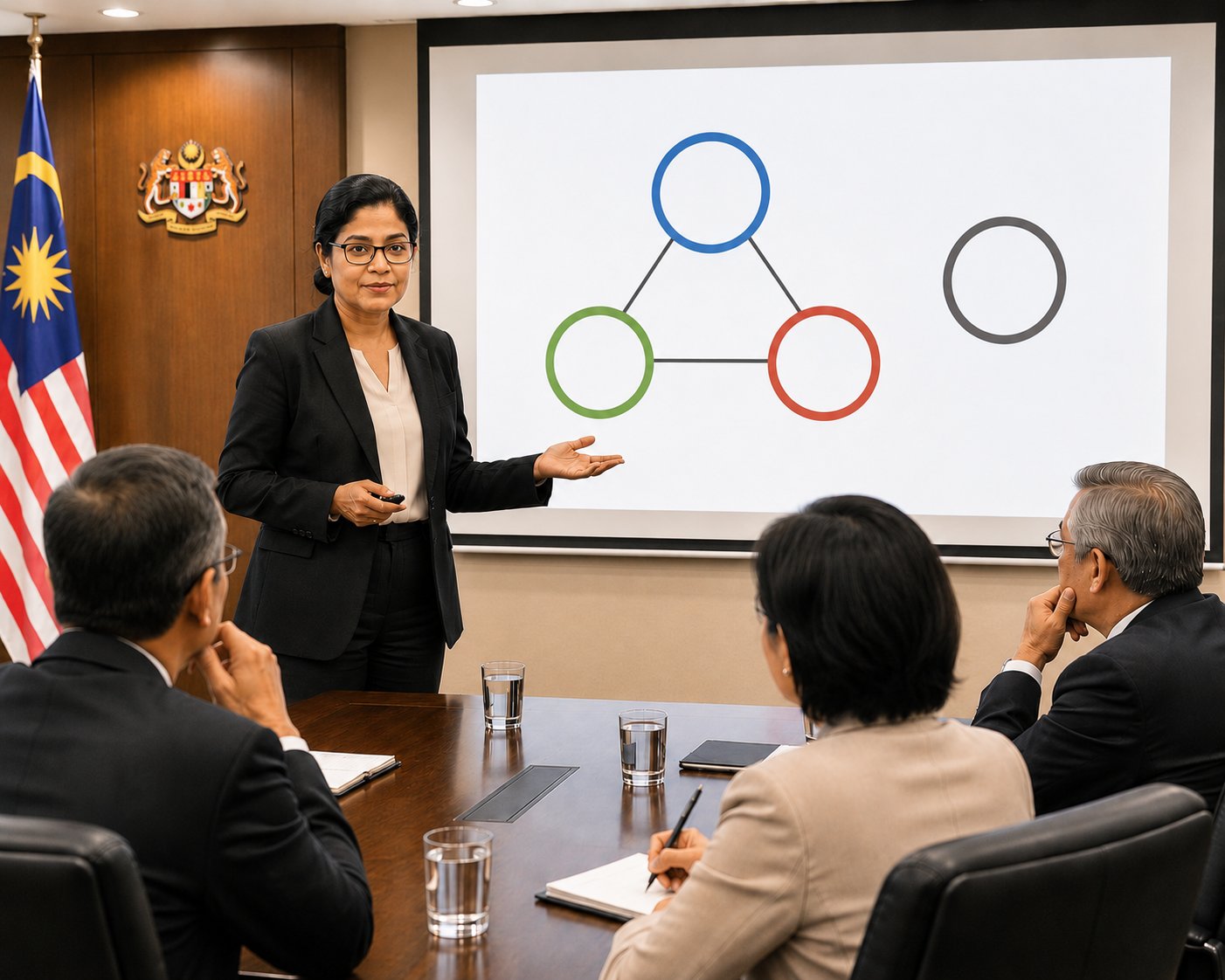
Dr. Rohini presents the four-circle framework to the GLC committee. Three coloured circles. One left empty. GLC boardroom. Presentation day.
Five firms had been invited. Two had attended the clarification session. Two submitted. Two were invited to present: Atherton Hale, and BrightBridge — the last Malaysian name in the field, and the firm that should not, on paper, have been in any of these rooms. They presented WHAT WE BELIEVE. The first question came from a younger deputy, holding the appendix open.
A Younger Deputy
"The diagram in your appendix. Three categories are defined. The fourth is blank. Is that a printing error?"
Maya
"No, Datuk. It's the finding."
She turned her copy of the appendix around so the diagram faced the committee — and the gesture was Grace's, though Dr. Rohini did not know that, and Maya did not say it, and Grace was at her desk in Bangsar with her Maslow diagram and her Hello Kitty and no idea that the page had just been turned in her direction.
Maya
"The three coloured circles are controls. They manage what the machine might get wrong — the risk of error, the need for verification. Red, amber, green: that's a governance system, and you can procure it. Every firm at this table today is selling you a version of those three circles. They are real and they are necessary and they will not, by themselves, make a single one of your twelve thousand people more capable than they were yesterday."
She tapped the empty circle.
"This one is not a control. It's the question the controls can't answer: what does the person become, with the machine beside them? That's not a risk axis. That's a growth axis. Risk management tells you what to prevent. This circle tells you what to grow. They are not the same thing, and no procurement in this country has yet treated them as different things — which is why the fourth circle in every other bid you've received today is filled in, and ours is not."
Maya
"The reason it's empty, Datuk, is the same reason the shade on your road can't be bought in a catalogue. It can only be grown. And it can only be grown in your own soil — in the particular people, in the particular place, in the particular year. No firm in London can ship you your fourth circle. Neither can we. What we can do is help you understand your soil, and design the conditions for something to grow in it. That is what this proposal is actually selling. Everything else — the controls, the audit systems, the governance framework — is the scaffolding around the soil."
The younger deputy looked at the blank circle on his copy for a moment longer than he had intended to, and wrote something beside it. It was the only annotation anyone at that table made all hour.
The second question came from the most senior deputy, and it was the right question, asked from inside the wrong frame.
The Deputy
"Dr. Rohini. Your competitors have guaranteed us a thirty per cent cost reduction within eighteen months, with penalties. You have guaranteed us — by your own document — nothing of the kind. Give me one reason this committee should carry your proposal upstairs."
It was a good question. The kind of question that had an answer prepared for it. The deputy had asked it cleanly, in exactly the words a man uses when he knows what the answer is supposed to be.
Dr. Rohini
"May I answer with a question, Datuk?"
A nod.
"Eighteen months from now, the penalties will have been paid or not paid, and the thirty per cent will have happened or not happened, and either way the people will be gone. So my question is not about eighteen months. It is the one my father used to ask in rooms like this one."
She let one second pass.
"What do you want your board to say about this in two years?"
What followed was a particular kind of silence, and Amir, who had sat in government rooms for more than twenty years, recognised it precisely. It was not the silence of people thinking. It was the silence of people counting — counting the months of their own postings, their own contracts, their own runway — and discovering that the question had been asked across a horizon on which not one of them expected to still be in the chair.
The silence held for four seconds, which in a boardroom is a geological age. At the side table, the minute-taker had stopped typing.
XLI
The Thursday Letter
Bangsar · the following Thursday
The letter arrived at 4:02pm: the evaluation period had been extended. No award would be made at this time. The Group had commissioned a further study on workforce transformation readiness.
Maya
"A further study. They asked the market a question, two firms answered it, and they've decided to study whether they're ready to hear answers."
Amir
"They asked the two-years question of a room full of eighteen-month people. This is what the room said."
Maya
"You didn't lose the tender. You planted it."
It was Amir who noticed the small thing, at the bottom. Queries regarding the further study were to be directed to Puan Noraini binti Hashim. He had seen the name once before, on a lanyard at a side table, attached to a woman who had stopped typing twice: once at his question, once at Dr. Rohini's. He wrote the name in his notebook. It was the only name in the entire letter that had ever looked up.
XLII
The Same Evening
A hotel room, Bangkok · Thursday, 6:10pm Kuala Lumpur time
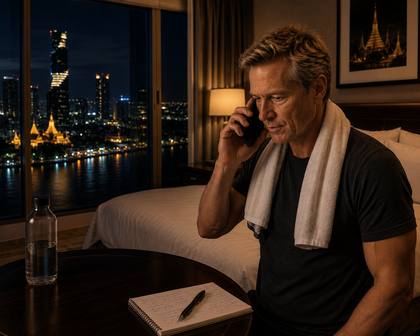
Bangkok, Thursday evening. The same letter. The Chao Phraya below. John Carrick reports to Andrew.
The same letter, word for word, had landed in John Carrick's portal alerts at 4:02pm, because procurement portals are the one institution that treats all bidders equally.
He read it twice on the twenty-ninth floor of a hotel he could have navigated blind, standing at the window with the Chao Phraya doing its slow brown work below. Then he poured a coffee he did not drink, opened his laptop to the pipeline forecast he had presented to London in April, looked at the cell that said GLC — award Q3, and called Andrew. It was 11:10 in London. Andrew answered on the second ring, the way he always did — not eagerly; punctually.
John
"They didn't award it. They didn't award it to anyone. They've commissioned a study — workforce transformation readiness. Twelve months if it's a day, eighteen if it's a committee, and it will be a committee."
He kept his voice level, which cost him something. "Andrew, I had the senior deputy at the guarantee. Not a feeling — a guarantee. Three weeks before the presentations, over a dinner I had arranged, he told me the committee had already seen enough. That the number and the penalties were their answer to a question they couldn't ask out loud in a procurement process. All we had to do was present without embarrassing ourselves."
Andrew
"And she embarrassed you instead."
John
"She gave him a question."
He turned from the window. "She stood in front of a procurement committee and read out a section titled What We Do Not Know. Out loud. Slowly. I've sold against price, against incumbents, against things I could prove and couldn't say. I have never sold against the truth, Andrew, because nobody has ever brought it to a tender before. And then she asked the deputies what they wanted their board to say in two years, and I watched the man I had briefed count the months of his own posting."
A pause. "He asked BrightBridge — in the room, on the record — for one reason not to take our number. One reason. I've closed on less a hundred times. She asked him a question instead of answering him, and the room went somewhere I couldn't follow it. I couldn't follow it, Andrew. And I had prepared the ground."
There was a silence on the London end. Not a hesitation — Andrew did not hesitate. An allocation.
Andrew
"The diagram. The circle they left empty. Did the room laugh at it?"
John
"No."
He paused. The annotation had been described to him, not by a committee member he could name in this call, but precisely enough that he could picture the handwriting beside the empty circle. "One of the younger deputies annotated it. Committees don't annotate, Andrew. They initial."
The silence this time went on one second too long, and John, who had spent twenty years being paid to hear the difference, heard it.
John
"I can recover this. I'll drop eight per cent and re-anchor before the study scopes. Or we offer to do the readiness study ourselves, gratis — whoever writes the study writes the award. Or give me a week and I'll have dinner with the senior dep—"
Andrew
"No."
The word arrived without weight, the way Andrew delivered all his decisions, as if reporting weather that had already happened.
Andrew
"You went because you knew. They went because they knew. In a field of five, that leaves three firms who only found out when everyone else did."
A pause — not a hesitation; an allocation. "The chairman's introduction is not a referral, John. It is thirty years of relationships with every ministry and GLC in this country. You cannot build that. You cannot replicate it. You cannot hire it away, because it is not in the people, it is in the institution." Another pause, the kind John had learned to wait through. "But you can acquire it."
"A deferral starves the small firm, not the large one. Every Thursday that passes without an award, her revenue gap widens, her people read the news, and the folder she has not answered grows heavier without my writing a word. Dr. Rohini has just played her best card, and what it bought was time. It bought it for us. I intend to thank her for it personally, one day."
John
"And the study itself? If they bid it, and win it—"
Andrew
"Then the firm we are going to buy becomes more valuable, and we will have paid for the diligence ourselves. There is no door here I have not already walked through, John. Write nothing to the GLC. Tonight I'll write to her again — nothing about the letter; patience reads best at the end of someone's bad week. And call the division head."
John
"And say what?"
Andrew
"Nothing. Let it ring through once. A man sitting at a kitchen table watching a phone ring is doing our work for us, at no cost, in his own time."
John
"It's been eleven months, Andrew. The lanyard still says Designate."
Andrew
"Designates who count months stay designates."
The line went quiet. Andrew did not say goodbye; goodbyes were a service he had discontinued years ago.
· · ·
At 6:30pm, in Dr. Rohini's personal inbox: Atherton Hale, the managing partner again, three paragraphs again. They understood BrightBridge was engaged in significant pursuits at present — they had been in the room; they knew precisely what pursuits — and they wished to assure her their interest was not time-sensitive. Perhaps, the letter suggested, after her current commitments had run their course. They remained, as ever, patient.
She read it twice and filed it where the first one lived. The folder named THURSDAY now held two emails. It was becoming, she thought, a correspondence she was conducting with no one — and the no one was winning, because the no one was the only party answering on schedule.
At 7:15pm, Amir's mobile rang. A +44 number. He watched it ring on the kitchen table, all the way through, until the screen went dark. No voicemail. The card was still in the jacket he had worn to the 38th floor — which he had not worn since, and had not hung up either. It hung on the back of the study door, exactly between in use and put away, which was, he was aware, a description of more than the jacket.
· · ·
In Bangkok, John Carrick did the last thing on the list and set the phone face-down on the desk, where it could not look at him.
His laptop was still open beside the forecast — open, behind it, to a video his wife had sent that afternoon: their daughter's school recital, eleven minutes, filmed from the third row, from the seat that was his. He watched it to the end with the sound low. Somewhere in the middle, a child who was not his sang flat, bravely, and was applauded anyway, and he caught himself thinking that nobody in his entire pipeline had ever been applauded for being honest about a wrong note, and that one woman in Kuala Lumpur had built a whole bid out of it, and that he had no idea how to sell against her, and that some part of him — small, unbudgeted, off-forecast — did not entirely want to learn.
Then he closed the video, and updated the forecast: the GLC award moved from Q3 to Q1 next year, and the line that read BrightBridge Consulting — acquisition moved from possible to probable.
Because that was the job. And he was very good at it. He had simply stopped being able to remember, at this hour, in cities like this one, ever deciding to be.
XLIII
The Empty Shelf
The pavement outside the tower, Petaling Jaya · evening
David had asked to meet her here, outside her own sealed building, at seven in the evening, which was how Dr. Rohini found herself standing next to him on the pavement, the two of them looking up at it like visitors. The tape across the revolving door had been renewed — someone's small act of diligence in a system otherwise asleep. Twelve floors up, the glass at the top held the last of the light. Behind it, dark, the window table where all of it had started, and where none of it had finished.
David
"Your father and I ate up there two hundred times, perhaps more. I counted once, roughly, on his anniversary."
He said it without sentiment, as a fact about a building. "Every difficult thing this firm ever decided, it decided up there. And now the firm decides things in a rented glass box next to a sign about vibes, and the strange part, Ron, is that the decisions have not gotten worse."
Dr. Rohini
"Is that what you wanted to tell me?"
David
"No."
He was quiet for a moment. "You asked me, the week of the earthquake, what I thought. I said I'd tell you when I knew. I want to amend that, because it was the wrong promise. Here is what I actually have to offer you now."
He kept his eyes on the building.
David
"Forty-five years, I thought what I carried was experience. It wasn't. It was inventory. Patterns, filed — nineteen-eighty-five, nineteen-ninety-eight, two thousand and eight, the pandemic. A man brings you the file that matches, and you look wise. I have been looking wise for the better part of half a century on the strength of a good filing system."
He turned to her. "This one has no file, Ron. I've checked every shelf. The shelf for this one is empty."
Dr. Rohini
"You're telling me the man my father trusted most has nothing."
David
"I'm telling you the strange part."
And here something moved through the old man's face that she had not seen on it before, and it took her a moment to identify it because it was so young.
David
"It doesn't frighten me. I keep waiting for it to frighten me, and instead — I find I'm curious. Genuinely curious, for the first time in twenty years. An empty shelf is a terrible thing for a man who sells precedents."
The smallest smile. "It is an interesting thing for a man who has eight or ten good years left and no longer has to pretend he's seen everything."
They stood looking up at the dark glass.
David
"I don't know what firms like ours are for now. Neither do you. Neither does that committee, or London, or the man with the conferences. For the first time since I was thirty, everyone in the room is the same age."
He put his hat back on. "I thought you should hear that from me before you hear it from events. Whatever you're carrying, Ron — and you are carrying something, I've watched you carry things since you were nine — you are not carrying it because you're failing. You're carrying it because there's no shelf. Carry it anyway."
She almost told him, then. The folder, the two emails, the patience of London. The sentence assembled itself and stood ready, and she looked at the old man who had just handed her his empty shelf as if it were a gift — because it was one — and she found she was not ready to set anything on it yet.
Dr. Rohini
"Thank you, Uncle David."
She had not called him that since the funeral. He nodded, and looked back up at the building, and let it remain unfinished, because he was David, and he had spent forty-five years knowing which silences were load-bearing.
XLIV
The Question
The glass room, Bangsar · Thursday, 4:30pm
The agenda item was called, in Maya's plain style, Planning under deferral, and it was the last item of the afternoon. On the whiteboard behind the screen — surviving three weeks of other people's meetings because nobody on the floor had felt entitled to erase it — were four circles. Three coloured. One empty.
They were all there. Dr. Rohini at the head. Amir beside her, notebook open, glasses on. Faridah across from him, a cup of coffee at its exact right angle to her notepad. David in the corner chair he had quietly adopted, as if he had simply been there all along and the rented room had caught up to him. Maya at the screen. She had built the picture without drama: the pipeline, the MoH renewals, the governance-as-a-service revenue beginning to arrive, the gap where USD 4 million was now a letter about a study. The firm was fine. The firm was suspended. Both things were true, and her slides said both.
Maya
"Last item. The further study. I called the Transformation Office for a timeline — for the record, a Puan Noraini took the call, and she was more helpful than the letter."
A beat. Amir looked up from his notebook.
Dr. Rohini
"Has it been tendered?"
Maya
"Not yet. Nothing on the portal. Noraini said the scope was still being drafted — she chose the word carefully, I thought. As if the drafting were the difficult part."
Amir
"It will be small when it comes. Scoped the way GLCs scope these things — a short team, twelve weeks, six months at the outside — I'd put it between two hundred and five hundred thousand US. Pocket change beside the award."
He said it without looking up from his notebook, where a name had already been written in the margin. The only name in the Thursday letter that had ever looked up.
Amir
"And the only document in that building the four million will have to obey."
Nobody answered that, because there was no answering it; it simply joined the room's inventory of true things.
Maya
"Which means we plan a year in the dark, and I don't want to plan a year by guessing what they'll decide. I'd rather plan backwards from something we decide."
She clicked to her final slide. It was blank except for one line, and she read it aloud as a matter of procedure, with no idea in the world what she was holding.
Maya
"So — the question I'd like us to leave with. If the study takes a year, and the award lands wherever it lands: two years from now, what do we want this firm's board to say about all of this? I'd like to plan backwards from the answer."
The rented room went quiet.
David had gone very still in the corner chair. He was looking at Maya — not at the slide, not at the blank where the answer should be — at Maya. At the firm's youngest senior person, who had just asked, almost word for word, the question Dr. Krishnamurthy had asked across forty years and two hundred lunches at a table that now sat dark behind hazard tape twelve floors above them. She had never met him. She did not know whose question it was. It had simply gotten into the firm's water, the way the protocol had, the way the cup and the column had — the way things outlive the rooms they were born in.
Faridah was looking at the whiteboard — at the four circles that three weeks of other people's work had not erased. She had filled in the human verification column every day this week. She had been doing it without being asked, without being reminded, without the architecture of accountability that had been built to hold the habit in place. She had been doing it, she understood now, sitting in this borrowed room with this borrowed question hanging in the air, because it was hers. The column was hers. The twenty-three years of judgment behind it were hers. The system did not replace what she knew. It simply gave what she knew somewhere to be.
Amir set his pen down. He did not close the notebook. The name in the margin would keep.
David turned his head, slowly, to Dr. Rohini. And Dr. Rohini looked slightly to the left.
He had known that tell since she was nine years old — had watched it across three decades of her father's lunches, had recognised it the afternoon she walked into the firm her father left her and did not know what her face was doing. It meant she could see the answer. It meant the answer was somewhere between terrifying and necessary. It meant she was not yet ready to say it out loud in a room that contained other people.
He did not say anything. He had spent forty-five years knowing which silences were load-bearing. He watched her look at the answer — somewhere just left of all of them, where answers live before they become decisions — and understood that the series of choices that would define the rest of his old age, and hers, had not yet begun.
That it would begin soon.
The room waited. Outside, the city went on being Bangsar on a Thursday, indifferent to the quality of what was being decided inside its borrowed glass rooms. On the far wall, GOOD VIBES ONLY sat dark and unhelpful, as it had been all week, as if even the neon knew this was not the moment.
· · ·
End of Series 2.
· · ·
Somewhere east of PJ, the new crane stood mid-arc against the evening, holding what it had been holding for five weeks. On a desk at MBPJ, a ninety-six-page report lay complete, correct, and unsigned. And at noon the next day, on an empty co-working wall in Bangsar, a neon sign switched itself on and announced GOOD VIBES ONLY to a room of people who had stopped noticing it, working anyway.
In the glass room, after the lights went off, four circles stayed on the whiteboard. Three with names. And one that nobody, anywhere, had yet earned the right to fill in.
· · ·
Where It Began — Series 1
The Putri Protocol
The Wednesday in Petaling Jaya. A report nobody checked, a folder named HOLD, and the analyst who caught all of it. The story that started the system.
The verification discipline. The governance system. The questions a board has to answer before it trusts the machine. The programme is built around exactly these situations — live, from your actual job.
The people of The Empty Circle — Series 2 of The Putri Protocol.
Returning from Series 1
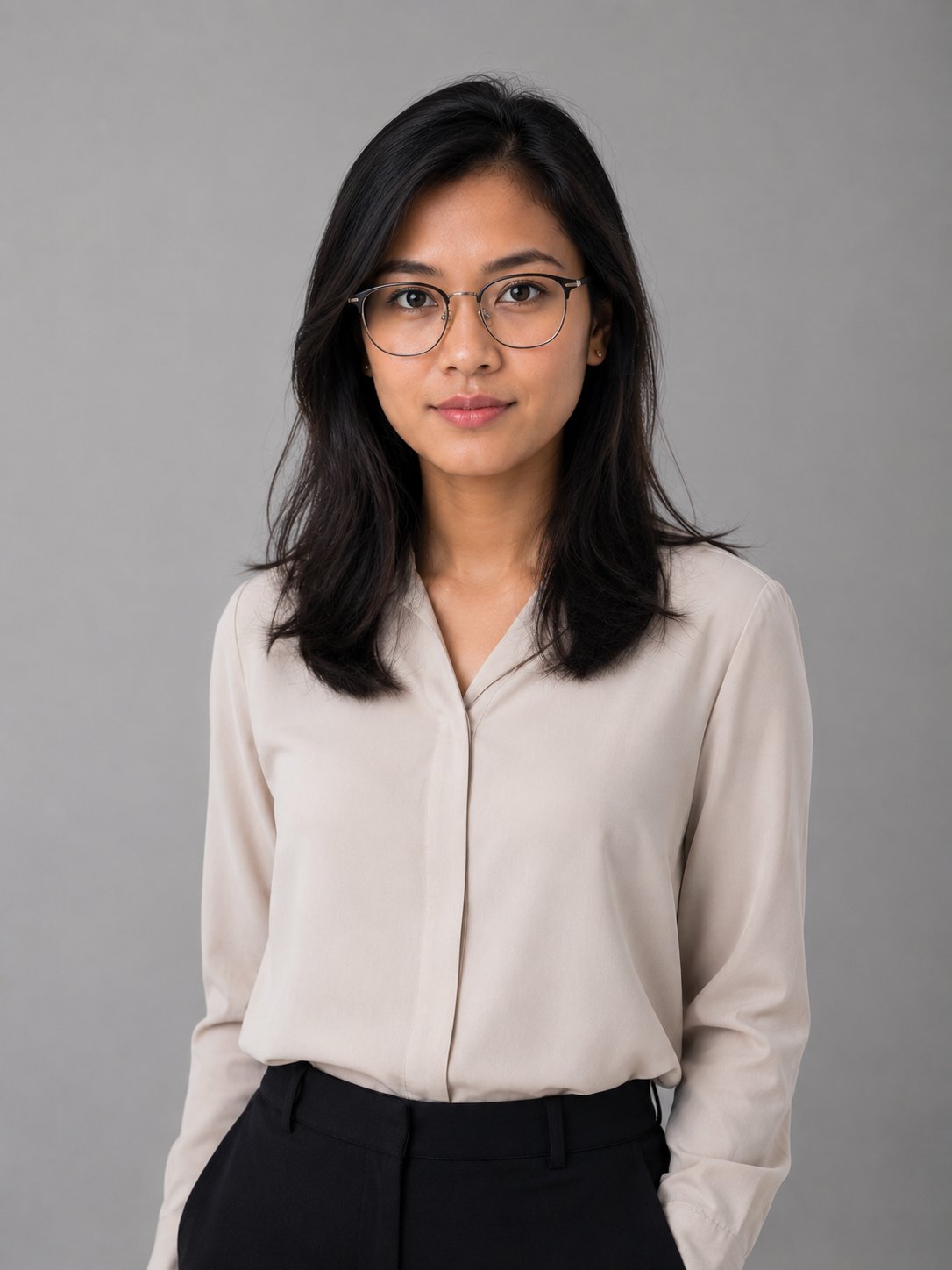
Maya Chin
Training & L&D Consultant · BrightBridge Consulting
Thirty-one. Four years at the firm. She draws a line down the centre of every notebook page — things to remember, things to act on. Under pressure and short on time, she used a free AI tool without checking its output, and the report nearly went to the Ministry of Health with four errors. She invented the AI Use Statement by instinct and added steps six and seven to the verification checklist on her own initiative.
In Series 2, she builds two complete bids — WHAT WINS and WHAT WE BELIEVE — and cannot make them one. She names the empty circle. She holds the founder’s question at the end of Chapter VI and does not know whose it is or what she is holding.
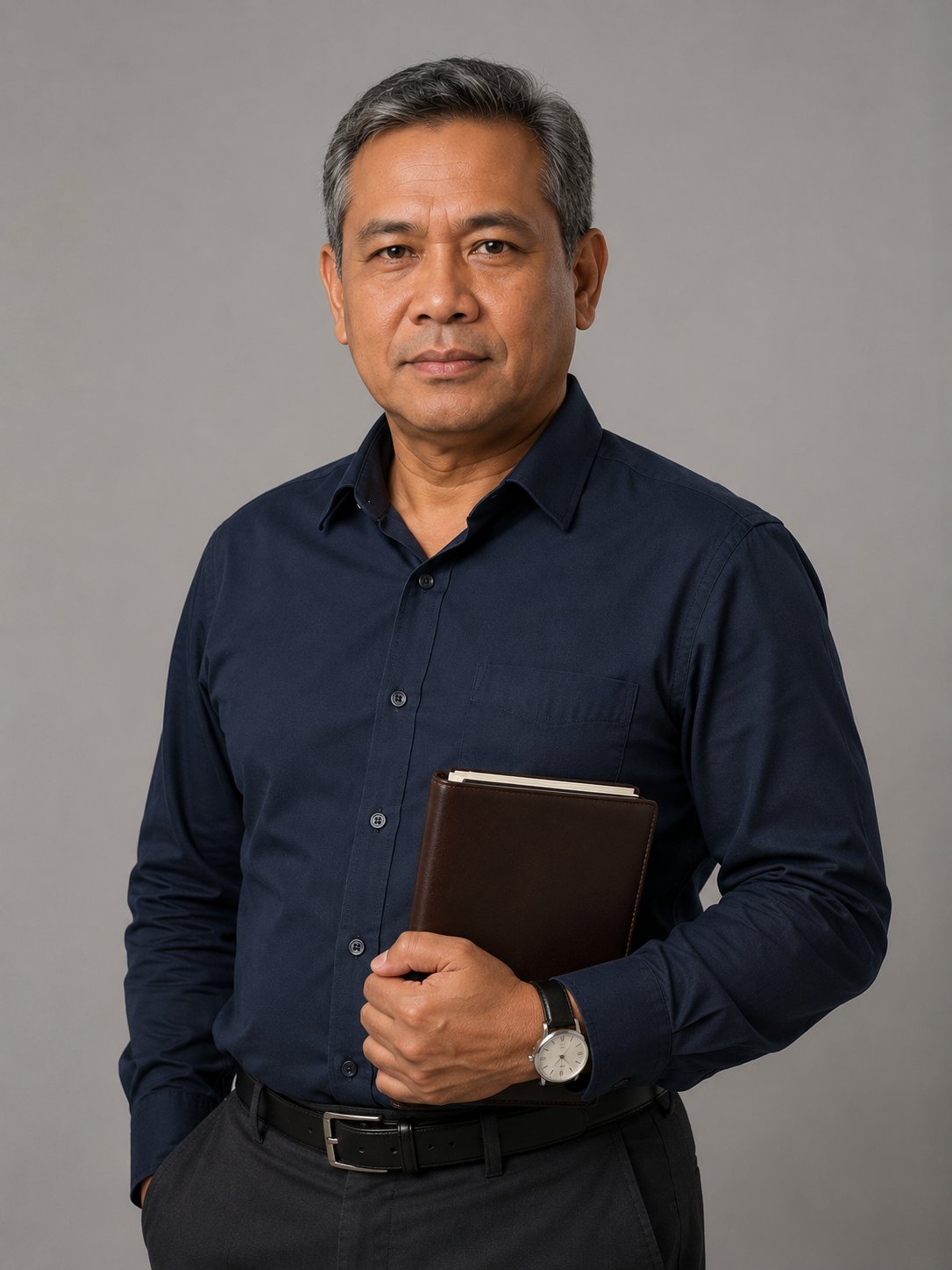
Amir
Head of Public Sector Division · BrightBridge Consulting
Fifty-two. Nine years at BrightBridge, thirteen before it in government-linked consulting. He built the Public Sector Division from nothing. He reads everything slowly, from the beginning, without skipping — the way you read something when your name will be the last line of defence.
In Series 2, he writes section 3.4 of the bid — what twelve thousand strangers could become — in the same week a formula decides what his own daughter no longer is. He does not say so once. In his notebook: Puan Noraini binti Hashim. The only name in the deferral letter that ever looked up.
Putri
Business Analyst · Fintech company, KL · Amir’s daughter
In her twenties. Her father’s stillness, her mother’s directness. She attended GenAI for Practitioners on her own time, for her own reasons, and caught four errors in ninety minutes at her father’s dining table with a training handout. She never found out the protocol was named after her.
In Series 2, she is eliminated in a video call where the severance formula is wrong. She corrects it. She does not cry. Her notice period produces a wiki titled For Whoever the Next People Are. She asks: if nobody can tell me what humans are for now, I will go and find out.
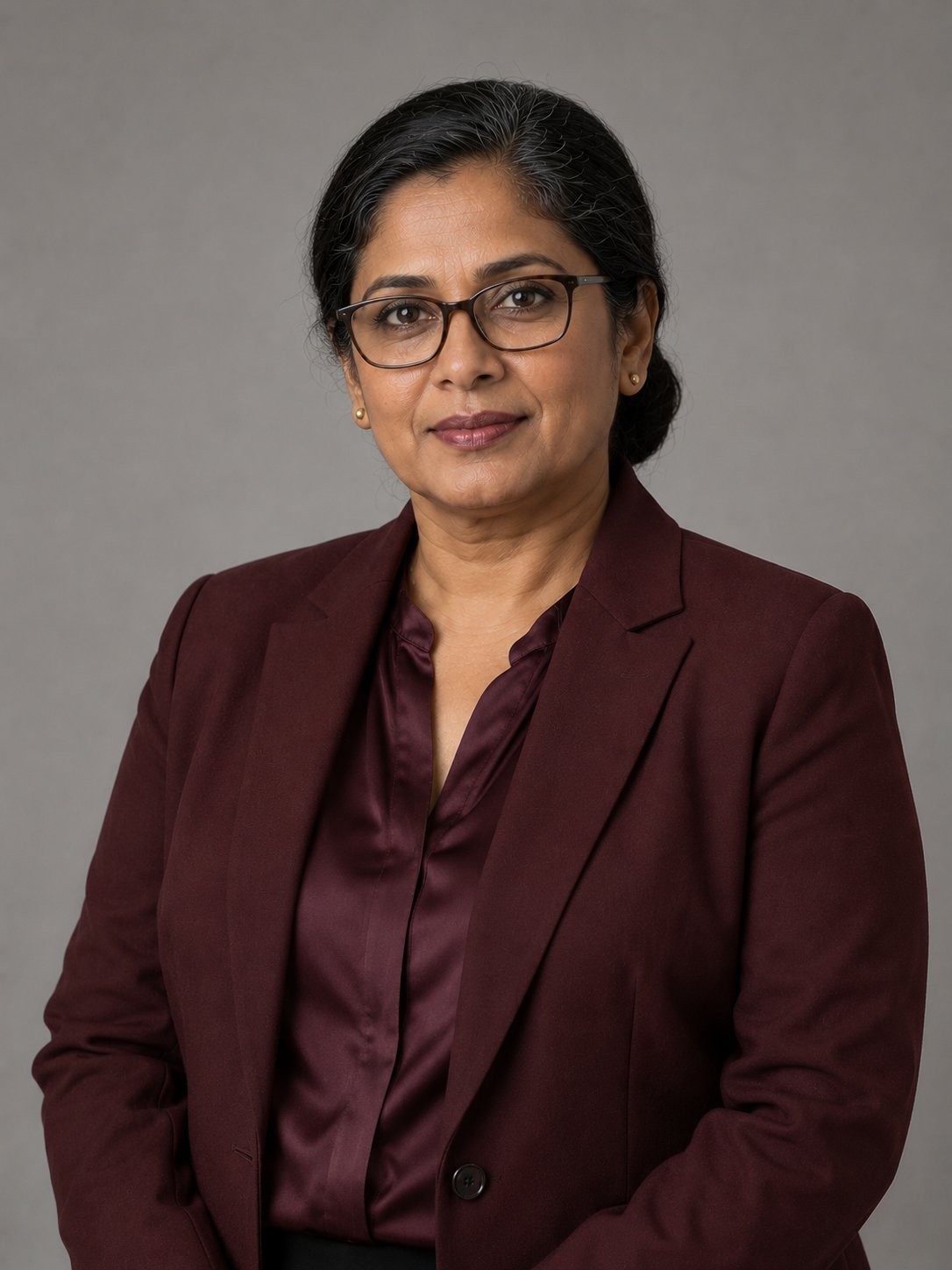
Dr. Rohini
Managing Director · BrightBridge Consulting · Daughter of the founder
She inherited the firm from her father and carried it forward. Her father’s question — What do you want your board to say about this in two years? — has lived in her practice so long she has sometimes forgotten whose it was.
In Series 2, she has a folder named THURSDAY on her laptop. It holds two emails from Atherton Hale. She has not replied to either. On a pavement outside the sealed tower, she calls David “Uncle David” for the first time since her father’s funeral — and almost tells him about the folder. Her tell: she looks slightly to the left when she can see the answer but is not yet ready to say it out loud.
Faridah
Head of Operations & Shared Services · BrightBridge Consulting
Fifty-six. More than twenty years at BrightBridge. She built the firm’s delivery infrastructure without a template. When the earthquake struck she held her cup on its saucer and did not let it spill. On the pavement, she had ninety people confirmed in three hours using a structure she built on the spot.
She called Mr. Siva — a fifteen-year relationship born from a crisis she solved overnight — and had a floor in Bangsar in forty minutes. When she saw the Human Verification Column, she looked at it for a long time, said nothing, and two days later filled in the first entry without being asked. Her silence is not disengagement. It is assessment.
Sixty-seven. He puts his phone away when someone approaches. He and Dr. Rohini’s father ate at Ong’s Restaurant two hundred times, perhaps more; he counted once, on his friend’s anniversary. It is David who brings the GLC tender — by invitation, not by portal.
On a pavement outside the sealed tower, he tells Dr. Rohini that for forty-five years he thought what he carried was experience. It wasn’t. It was inventory. This one has no file. The shelf for this one is empty. Carry it anyway. He spent forty-five years knowing which silences are load-bearing.
In his seventies. He won the tender in 1995. He never left. When the earthquake struck he stood at the service counter with one hand resting on it — resting, not gripping — watching his room sway the way a man takes attendance. Then: The kitchen. Check the gas.
Every morning since the tape went up, he walks to the tower and stands on the pavement and looks at the top of it. He is not inspecting anything. He is visiting. He will not move thirty years downstairs because the men with the file are frightened of their own pens. He is waiting for a signature. He knows the difference between that and courage.
Kevin Ong
Manager · Ong’s Restaurant
Mid-thirties. Returned from Melbourne with a hospitality degree and the good sense not to change what didn’t need changing. He had the window table ready when they arrived. He did not need to be asked. In Series 2, he brings his laptop to a kopitiam below his father’s flat and tries, with great care, to be sensible about the projections. His father is not moved by projections.
Late thirties. Eight years as a clinical psychologist before leaving the clinic for a doctorate in organisational behaviour — she did not leave the patience when she left. She listens the way clinicians listen: completely, without rescuing anyone from their own sentence.
When Maya put the page with the four circles on the table of a kopitiam, Grace turned it around — the way clinicians turn a scan toward a family — and explained why the empty circle could not be filled in, and why any vendor who offers to fill it for a fee is lying. She is the reason section 3.4 exists. She has not yet read it.
John Carrick
Regional Director, ASEAN (Designate) · Atherton Hale · Bangkok
Late forties. British. His lanyard has said Designate for eleven months. He is the most likeable man in the room — that is what makes him effective. He stopped writing down slides twenty years ago and now writes down only people. He is the intelligence in this story; Andrew is the strategy. John finds things out; Andrew decides what they mean.
Three weeks before the GLC presentation, John arranged a dinner. The senior deputy told him the committee had already seen enough. All Atherton Hale had to do was show up. John told Andrew the ground was prepared. Then Dr. Rohini asked the committee what they wanted their board to say in two years, and John watched the man he had briefed count the months of his own posting. He calls Andrew from Bangkok that evening and describes the annotation on the empty circle — described to him, precisely, by someone he does not name on this call. He updates the forecast anyway. That is the job. He stopped being able to remember, at altitude, ever deciding to be good at it.
Andrew
Managing Partner, ASEAN Expansion · Atherton Hale, London · Never depicted
He answers on the second ring — not eagerly; punctually. He does not hesitate; he allocates. He told John Carrick that the deferral was the best thing that had happened to them since the earthquake — that a deferral starves the small firm, not the large one. He intends to thank Dr. Rohini for it personally, one day. He discontinued goodbyes years ago.
He has written twice to Dr. Rohini. Both letters live in a folder named THURSDAY. He has never been seen and never called anyone directly — Andrew writes; he instructs John to make the calls. The +44 number that rings on Amir’s kitchen table is John’s, on Andrew’s instruction. Andrew exists in this story as a voice heard only by John, and a patience that does not require answering to be felt.
Andrew is never depicted — no portrait, no silhouette, no hands. Represented here by the city he calls from.
GenAI for Practitioner · P2P Talent Development
The Programme
The verification discipline that holds a USD 4 million tender to account. The governance a board needs before it trusts the machine with people\'s livelihoods. If The Empty Circle resonated, it is because these situations are real — and the programme is built around them.
What this programme is
GenAI for Practitioner is a two-part programme designed for working professionals who are already using AI tools — or managing teams that are — and need to use them with confidence, accountability, and legal compliance.
Part 1 covers the practical skills: how to prompt effectively, how to verify AI output, how to protect organisational data, and how to build the habits that prevent a near-miss from becoming a crisis. Part 2 covers governance: ISO/IEC 42001 readiness, PDPA compliance for AI processing, audit systems, and how to turn AI governance into a professional service — not just an internal policy.
Both sessions are built around participants' real job contexts, not generic scenarios. You leave with artefacts you can deploy — not slides you will review once and archive.
GenAI for Practitioner
Programme 1
AI for Practitioner
HRDC: DT-P1-GAIP · No technical background required
Traffic light risk classification for AI outputs
The Putri Protocol — structured verification method
ISO/IEC 42001 gap analysis — where your organisation actually is
PDPA 2010 AI compliance assessment
The AI Interaction Log — built live using AI Code
The Human Verification Column — what it is and why it matters
One-page AI Use Policy — deployable before you leave the room
AI governance as a professional service concept
Who should attend
Programme 1 is for any professional who produces deliverables with AI assistance: consultants, training designers, L&D professionals, HR practitioners, operations managers, policy officers, analysts. No technical background required. If you have used ChatGPT or any AI writing tool in your work, this programme is for you.
Programme 2 is for managers, team leads, compliance officers, and senior professionals responsible for AI governance in their organisation. Programme 1 is mandatory — not because the content is gatekept, but because the governance you build in Programme 2 only makes sense if you have done the verification work in Programme 1 yourself.
How it works
Both sessions are one full day each, held in Kuala Lumpur. The two sessions are separated by a gap of two to four weeks — deliberately. Participants return to their real jobs between sessions and apply what they learned. They come back to Programme 2 not with good intentions but with evidence from the field: what worked, what surprised them, what they couldn't solve alone. That field evidence becomes the raw material for the governance work in Chapter II.
This is why Amir could report in Chapter II's opening check-in that his team had already run the protocol without him. The gap between sessions is where the learning becomes real.
Two separate one-day programmes in Kuala Lumpur, presented by P2P Talent Development and the Malaysia Project Management Practitioner Community (MPC). 100% HRD Corp claimable under SBL-Khas.